Thursday, August 23, 2012

What Have I Ever Lost By Dying

I lived for hundreds of thousands of years as a mineral,
And then I died and was reborn as a plant.

I lived for hundreds of thousands of years as a plant,
And then I died and was reborn as an animal.

I lived for hundreds of thousands of years as an animal,
And then I died and was reborn as a human being.

What have I ever lost by dying.

Rumi, as translated by Robert Bly

Not a pitch for reincarnation -- but then who am I to pronounce on that one? Rather a reminder of how a compulsion to cling to the status quo informs and directs our lives at so very many turns. What's the expression -- better the devil we know, than the one we don't.  The presumption, I suppose is that, in most cases, change will, at best, be a (scary) unknown; at worst, for the worst. So better to entrench right here. . . as a rock, a tree, or a mole.

I had a conversation this week with a farmer -- not a wholly difficult thing to do in Perth County. We happened to be passing fields nearing what ought to be the apex of their growing season; and, with them, talk of the annual ups and downs of crop yields, weather, drought, deluge -- good years and bad. He shared a story of a fellow farmer, an emigrant from Europe many years ago, who had prospered in his adopted country; having arrived with next to nothing as a young boy with his parents. Each year of this man's farming cycle is . . . well, what it is. He is described as applying best practices; then allowing things to unfold. In particular, I was struck by this man's apparent sangfroid around the possibility of having built and built -- only to have it undone by the vagaries of market prices or weather or some other uncontrollable element in the equation that is agriculture. The ever-present risk of returning to his 'roots' (as it were) and being penniless once again. My friend characterized him as having a very 'balanced' attitude around this possibility: he would simply begin again.

It put me in mind of the villainy wrought by the alternative -- that would be remaining attached to what is, fearful and avoiding of the unknown, of change. Two other conversations this week: one that had seen a man dig a progressively deeper financial hole in a (failed) attempt to maintain a standard to which his family had become accustomed -- and his equally vain effort to keep it all a secret; and a second, which saw a man stay in a job that was 'secure', but soul-destroying, again because the alternative would be seen (and perhaps experienced) as irresponsible, risky, self-indulgent. In both cases, fear-based decisions to maintain the status quo fostered relationship unhappiness, bordering on disaster, anxiety and depression. 

Jon Kabat-Zinn, in Wherever You Go, There You Are, his little book of thoughts on mindfulness practice, talks of 'letting go' in very similar terms:

Letting go means just what it says. It's an invitation to cease clinging to anything -- whether it be an idea, a thing, an event, a particular time, or view, or desire. It is a conscious decision to release with full acceptance into the stream of present moments as they are unfolding, to let go means to give up coercing, resisting, or struggling, in  exchange for something more powerful and wholesome which comes out of allowing things to be as they are without getting caught up in your attraction to or rejection of them, in the intrinsic stickiness of wanting, of liking and disliking. (p. 53)

And one final word on change. Our tendency to see impermanent things as permanent, is, in a mindfulness framework, the very antithesis of a healthy meditative practice.  The underlying tenet of such a practice is that change is inevitable and constant. To attempt to artificially hold to stasis, the ongoing state of sameness (no matter how desirable that state might be; or no matter how fearsome the alternative is expected to be) is to work against the universe. One writer, in fact, describes mindfulness as the awareness of change as it unfolds. Not a bad working definition.

Monday, August 13, 2012

The Mindful Marriage

Mindfulness seems to be well on its way to becoming treat of the week. Applied to everything from anxiety to adolescents, post-trauma to pain, sadness to stress, one half expects to pull into the local take-away drive-thru' and, with every McMindful Meal receiving an extra large soft drink of your choice. So why not marriage?

I happened upon a review of a new book recently, How Can I Be Your Lover When I'm Too Busy Being Your Mother?, and it dawned that this might just be the mindfulness entree into this domain. The male and female authors, Toronto-based psychotherapists, appear to have nailed a number of the commoner, 'he said, she said' complaints that find their regular way into our offices. Sort of a 'Mars and Venus' look at the usual laundry lists and the knee-jerk defenses they elicit; with a bit of gender-specific perspective -- and some alternative approaches that might just avert the typical tape being played out yet again. They consider the male's 'convenient blindness' -- a penchant for walking past that pile of clean laundry waiting to be helped upstairs, or the emptied garbage can at the curb -- generally viewed by this lad's partner as laziness, shirking, not caring, or just plain obliviousness. They offer the alternate possibility that the male view may be as much driven by his immediate goals (where he's headed at the moment) and that anything not representing an impediment to that goal is generally (and easily!) ignored. 

Leisure and how it's defined comes under the microscope too. The authors maintain that men 'make a sharper distinction between work and play'; women frequently 'do a different kind of work to relax'. How often have I heard the 'I work all day; when I get home I want to read the newspaper with my feet up' defense; generally in response to the 'I could use a little help with the kids, cleaning up supper dishes, and walking the dog' plea. To the male, the maxim of 'a woman's work never being done' is more a matter of female choice or compulsion, than job description.

In the crosshairs as well is nagging. To the woman, her partner is just one more child that she can reliably count on to ignore the first five requests before being threatened into action; to the man, it's an 'I'll get to it . . . no need to go ballistic!' The gatekeeper/woman: 'If I want it done today, and done right, I may as well do it myself'; the man:  'nothing is ever good enough!' Meeting a standard or perfectionism; slap dash incompetent or never satisfied control freak.

Even raising the family is grounds for a disparate take on things. Smother-mother or lackadaisical dad. Helicopter mom contacts the university control tower for landing instructions as little Billy settles into his first 'home away from home'; dad hands three-year old Bobby the can of lawnmower gas to help jump start the BBQ.  Is there no middle ground?

The authors of course have their own, generally pretty grounded suggestions for reframing and resolving the above scenarios -- on both sides of the matrimonial fence -- in a less dysphoric way.  I was equally impressed, however, just how many of the general tenets we associate with mindfulness practice and principles have salutary application. How about non-judging: adopting the observer's role (vs. that of the 'fixer' or 'quality control monitor'), foregoing a critical, judgmental, evaluative posture. Or perhaps being a little more present: might this involve noticing that laundry, garbage can, or milk left on the counter and addressing now vs. later.

Does letting go have a place in all this matrimonial chaos? Could that look like being a little less attached to a particular outcome or standard; perhaps accepting what is vs. compulsively measuring the distance between what's before us and some ideal. Oh and how 'bout patience? The old grit in the marital machine of just whose timetable are we operating on ('gimme a minute and I would have gotten to it!')

Non-striving, the soothing of the need to have things the way the should be, or the way we need them to be, just might find a place in the mix. And what of the beginner's mind? That would be seeing a situation stripped of expectations, standards, negative predictions; and allowing that it may just be handled a little differently (and more satisfactorily) -- if I'm only non-judgmental, accepting, and patient!  And finally, trust -- of self and our significant other. Seeing both self and other as competent, interested, concerned, and caring.

There might even be room for some of those other wingy concepts: right speech, right view, right intention, and right action. So, will that be two all-beef patties, special sauce, on a sesame seed bun -- with a side order of equanimity and compassion?

Monday, July 16, 2012

Of Blasphemy and Boilerplate

Ah, those "rabid and deranged anti-cycling nut-jobs versus the humourless, wannabe-martyr, pro-cycling zealots": this from Globe columnist, Andrew Clark's piece last weekend on the 'debate' around how to make cycling safer, as he characterizes the factions engaged in this 'discussion'. (http://www.theglobeandmail.com/globe-drive/car-life/prying-the-lid-off-the-cycling-debate/article4386683/).  Aside the rather balanced presentation (in opinion pieces, how exceptional is that!), what caught my attention was the glaring absence (in the respective positions, not Mr. Clark's editorial) of middle ground.

What seems to have 'blown the lid off' (pun intended) is the great 'to helmet or not to helmet' quandary -- and only because there's so much competing 'evidence' (both for and against). Mr. Clark cites the main findings from the Ontario Coroner's Office review, somewhat darkly entitled Cycling Death Review -- both consciousness raising efforts at all community levels and ways of making the roads safer with facilitation of shared use (bike lanes, safe passing distances, etc.).  But evidently it all comes down to those 'dorky little lids', the battle lines drawn up tighter than a helmet strap on a double chin, each faction quoting research that supports its particular perspective.

Con: Violation of individual choice (no doubt, there's a Charter of Rights challenge lurking somewhere in the wings). Drivers actually targeting cyclists in helmets (Hmm, certainly my focus when I get behind the wheel vs. getting on the wheels). Allowing communities to ignore 'meaningful infrastructure change' by passing restrictive helmet laws. Killing (poor choice of words) ride-sharing programs. And Pro: Helmets are like seat belts -- they don't prevent accidents; but you may just survive one (reducing serious injury by 85%). Good modeling -- how do you expect your kid to wear one if mummy and daddy don't. And so it goes.

Caught up in a good old fashioned gossip session this same weekend, I was reminded of just how compelling -- and distorting and selective -- extreme postures on near anything (or anyone) can be.  A delightful, though independent thinking and perhaps just a little opinionated friend was waxing descriptive on the cons (not even a token 'pro' in sight) associated with a mutual acquaintance whom I've always found, well let's just say, benign. (That's a polite way of saying that there are elements with which I struggle -- but I've always seen these as 'quirky' rather than overtly malicious.) Descriptors as controlling, self-absorbed, disrespectful, oblivious, obtuse. . . well, I think you likely get the drift, surfaced as the rant built steam.  I was particularly curious about my own subjective response to this (to understate) extreme characterization. I immediately felt compelled to either jump on board, to scan my own opinion repository for 'supportive data'; or to oppose, to rebut, to challenge these attributions that didn't resonate with me to any real extent. Where had that middle ground gone?

So unsettling was the experience that it spurred a bit of additional self-examination, introspection. As a sort of word-association variant, I made a short list of various folk in my immediate experience and, trying my best not to clutter up the landscape with facts, attached a 'valence' (little +'s or -'s) to each.  The egotistical one, the slick one, the self-important one, the generous one, the patient one. . . this was pretty easy -- seeing the world in two dimensions, pro or con, black or white. And beyond this, how simple it was to find evidence to support each of these unitary appraisals. Then came the hard part of the exercise: stretching that characterization to include the offsetting, or more properly balancing elements . . . that complete the picture, acknowledge the complexity of the human state. Suspending the stereotype and restoring the middle ground. Less facile but decidedly more representative.

In mindfulness practice, a sought after state is that of equanimity, a balanced, calm, emphatically non-polarized posture. One that emphasizes the middle ground and typically one that is only available with some measure of intention, of conscious consideration -- no automatic judgments here. The challenge it would seem is to entertain the whole package -- not just those 'juicy' and immediately satisfying epithets that characterize the extremes.

With our cycling 'camps', the goal(s) -- sharing space (in this case, the road), keeping people alive and fit, maybe even doing the planet a favour -- somehow get lost in the stereotyping and adversarial stances, reducing the issue to an aspect that is able to be vilified or celebrated; attributing all manner of 'personality characteristics' to the occupants of one position or the other. In our day to day, how difficult it is to first notice that we're 'sliding to the edge' once again; and secondly, pulling it back with a little injection of equanimity. Put that on your pillow and sit with it!

Monday, July 2, 2012

Open for Business. . . or Out to Lunch


A coach's white board detailing an in-bound play with 12" left on the clock? Snow flakes on a grade four window display? Cell division in cheese bacterium too long left on the counter top?  A sociogram modeling growth of adolescent communication patterns? (Well maybe the latter two are about the same thing.)

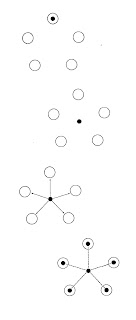
A number of conversations in the past week would point to the cute little doodle at the left representing the hoped-for evolution of self-awareness as we engage a regular mindfulness practice.

Conversation one surfaced with the guilty confession that a whole week had been consumed reading fiction -- the equivalent of 'skimming while Rome sizzled'. In short, getting lost in several good books, as it turns out, to avoid a direct look at more urgent material -- 'happily' pushed into the periphery. Conversation two, a little less explicit, made its point through some subtle, critical self-references, in an otherwise confident, self-assured individual -- begging the question of 'where'd that come from?'  And conversation three -- this from a new meditative practitioner -- commenting on the conflicted presence of an improved memory and increased emotional distress. Pretty diverse data!

What element all three seemed to share was that of a working consciousness that excluded, wholly or in part, perhaps less desirable or even feared aspects of a more complete self. In short, operating from a compartmentalized, truncated, or circumscribed self.  Back to the doodle for a moment. The schematic is borrowed from a writer on psychosynthesis, an approach to personal psychology that, like Jung and other turn of the century theorists, advocated a 'full consciousness' as the healthiest (least neurotic, in Jung's terms) approach to psychological maturity and function.

The four 'little snowflakes' represent different stages of consciousness or awareness in a given individual. The black dot identifies those elements of self of which the individual is aware and engages regularly; the small circles, various aspects or 'sub-personalities' within the individual; and the lines (or absence thereof) reflecting the degree to which the individual is aware of these aspects.  No line or connection = no awareness;  a dotted line, partial or sporadic awareness; a solid line, full awareness.  In the top diagram, we have a relatively common circumstance where a person essentially 'places all their ego eggs in one basket'. They are fully conscious of only a small part of their complete personality and are evidently quite content to live and operate in this little corner of their world. The downside of this arrangement is that, sooner or later, these other 'shadow aspects' will make their presence known; often with, because these are relatively 'foreign' to the individual, chaotic and disturbing results.

Diagram two is a slight improvement and perhaps the commonest circumstance of all. In this situation the individual has a reasonably 'balanced' ego -- but precarious, as he/she is still quite in the dark regarding all those 'relatives' lurking in the shadows; no lines between the ego/active consciousness and sub-personalities. Conversation one is an example of this: blinders in place, avoidant practices fully engaged -- all with the aim of keeping at bay vague, disturbing, or openly feared issues. An excellent recipe for anxiety.

With schematic three we're getting somewhere. A 'balanced', centrally positioned ego and an awareness of the 'siblings in the wings'. But not quite there just yet. Awareness is not acceptance or engagement. Conversation two is an example. Here the individual 'names' an aspect of self -- but in pejorative terms, suggesting shame and embarrassment around, rejection of that aspect. The 'step-sister' is acknowledged -- but sent to the woodshed. Equally conversation three has elements of this mode of function. With a newly minted mindfulness practice, he/she has moved from 'stage one', wherein avoidance of issues had (of necessity in earlier times) been so 'successful' that it bled through to interfere with attention to (and consequently memory for) just about anything that smacked of disturbing material; to stage three where, urged to 'sit with' (vs. shut out) such material, the individual had become more conscious of it, and less reactive to it -- but continues to be disturbed by its presence.

Finally, diagram four. Here we have an individual fully aware of and participating in all aspects of self. The ego is 'spread around', engaging all sub-personalities -- whether sunny or dark, socially facilitative or suspect. This individual is unlikely to be blind-sided or anxious; is likely to present as authentic in relationship; and might be seen as someone who fully knows and accepts themselves.  Part of the 'Who Am I' meditation practice is an important and courageous step toward this type of awareness. Kind of the equivalent of passing the ball to all our personal 'players' at once -- imagine how effective that would be when you've only got 12" to make that basket!

Monday, June 25, 2012

Do They Even Know?

To Create an Enemy, Sam Keen

Start with an empty canvas
Sketch in broad outline the forms of
men, women, and children.

Dip into the unconscious well of your own
disowned darkness
and, with a wide brush
stain the strangers with the sinister hue
of the shadow.

Trace onto the face of the enemy the greed,
hatred, carelessness you dare not claim as
your own.

Obscure the sweet individuality of each face.
. . .
Exaggerate each feature until man is
metamorphosed into beast, . . 

Quite a nasty recipe!

A few words on projection. An online definition summarizes this process as follows: "a psychological defense mechanism wherein a person subconsciously denies his or her own attributes, thoughts, and emotions; then ascribes them to the outside world, often to other people. Thus, projection involves imagining or projecting the belief that these aspects of oneself originate in the feelings of others." Freud, the originator of the term in its modern use, maintained that projection's primary 'use' was that of helping the ego split out emotions which the individual finds disturbing or unacceptable as personal attributes; thereby reducing one's anxiety. A rather unusual variant of 'not in my backyard'!

If we accept Freud's contention that projection develops as a 'defense mechanism' in aid of making our lives a little less harried, it can't be all bad. Right?  After all, some other of these 'mother's little helpers' include sublimation (shifting socially unacceptable motives to a more benign form: better to play out international differences on a World Cup pitch with a football, than on a field of battle with guns!); identification (modeling oneself on the admired attributes of another's behaviour or character); even humour and rationalization often make the 'helpful cut'.

Evidently, from Sam Keen's take on this process, the answer to the above question would be: 'well, not necessarily -- helpful, that is'.  As is so often the case with matters addressed in a regular mindfulness practice, the pivotal issue here is one of awareness.  Sam's sardonic piece portrays what can (and so often, does) happen when we distance ourselves from our own process, fail to own our own issues and, for the sake of our own comfort, project them safely away from 'our own backyard'. The sequence he lays out is common enough:
1.    pick a neutral and generic target;
2.    identify (unconsciously) those issues with which we regularly struggle and are perhaps the least satisfied with in ourselves;
3.    attach a pejorative label to our (previously) generic figure -- befitting the content we're about to assign him/her;
4.    remove our intimate connection with this person; making him/her less the individual and more 'representative' of a 'group' or type;
5.    and finally, engage the 'black and white', all or none process of polarized thought -- leaving only the negatives and conveniently forgetting or downplaying the mitigating positives.

Last week's blog suggested a simple meditation of self-exploration: Who Am I? A variant on this exercise as we sit is to become aware of subtle signals that may foretoken a bit of projection at work. The signs are simple enough: those issues or people who most trigger us; those individuals we most readily identify as representative members of a particular group / point of view -- and feel most compelled to vilify and paint (a la Keen) with a single colour, removing all the nuances that necessarily comprise the 'complete individual'. The awareness in this case: turning one's vision inward (again); and 'catching' oneself in the act of projecting. Making oneself conscious -- always preferred to being 'unconscious'.

Audio Version: http://db.tt/AWZEP44u 

Who Am I? podcast link from Sounds True: http://www.soundstrue.com/weeklywisdom/?source=podcast&p=6327&category=AGM&version=full

Sunday, June 17, 2012

Of Integrity and Ego

When I search the etymological roots of integrity, I find its origins are from the Latin, integer, translating as whole, intact, untouched, complete -- and it started me thinking. Even in English, integer carries a very similar meaning: 'a whole number, not a fraction; a thing complete in itself'. How rare!

I suppose what pushed this concept fully into consciousness this past week was the sinking awareness of how 'spinning' finds its confusing and unhelpful presence so frequently into our days.  In the selective retelling of an exchange with a third party, with the casual exclusion of a detail or two; the adoption of a point of view, stressing 'facts' that support, downplaying those that don't; the reshuffling of story elements, to minimize an anticipated confrontation; or simply reversing oneself -- as the situation 'demands'. Rarely are these 'spun versions' rooted in malice or the intent to deceive; often rationalized as 'just good story-telling', perhaps a memory lapse; the need to save face, self-enhance, or just to 'not look the fool'. All at relatively little cost -- save personal integrity.

Casting about for a little 'light entertainment' a few days ago, my wife and I streamed an episode of a recent BBC sitcom, 'In The Thick Of It', a satirical look at the politics and personnel of a marginal ministry in the British government. And its daily challenge of justifying its own existence, its programs, what it supports and what it eschews; and most particularly, the irrelevance of fact and truth and the preeminence of appearance and press- and public-friendly postures -- even if it means reversing itself multiple times in a day. My wife's summary comment was that this perhaps would have been amusing -- if it wasn't so close to the truth.  

Which may be why The Ides of March caught our shared attention as our 'home movie of the week' choice.  More politics -- but with a 'spin'. As the title suggests, the film is a contemporary re-examination of the motivations that fueled the political assassination of Julius Caesar, set against the backdrop of an Ohio Democratic primary with the victor an almost shoo-in for the presidency. The spin in this case is, ironically, found not in the political rhetoric, which would be just too cliched to be interesting; but in the morality of brinkmanship, party and campaign loyalty (or, more properly, the lack thereof), and the chess games that measure, position, and re-position -- always with the eye on the long term 'win'. To the extent possible, everyone 'wins' in the short-run, save the single character who maintains a position of personal integrity throughout. The cost of victory, in typical Faustian fashion, is one's soul, as the hollow-eyed 'winners' suit up for the next round; and the loser, accepts his 'prize': a dignified exit from the world of politics (and spin), and gets on with his 'integrated' life.

What is evident is the 'end justifying the means' stance that informs most choices in the film. And most compellingly, the compartmentalization within self, the 'fractionation' of the individual if you will, that allows this process to continue. Carl Jung describes the process of maturing psychologically, somewhat tellingly, as one of growing individuation. In this process, elements of the immature personality, typically at that stage kept more or less in the dark, one from another, gradually begin to coalesce into a unified whole -- to integrate, become acknowledged and accepted by the individual as 'parts of him- or herself' -- for good or ill -- and begin to inform his/her choices in a fully conscious fashion. In short, the individual develops integrity -- both psychologically and morally. To the extent that this process is truncated or incomplete, our thoughts and actions are guided, at best, only by a part of self, generally one driven by ego -- and its self-enhancing, self-aggrandizing motives.

Mindfulness practice approaches this integrating process from 'the other end' -- but with the same, essential goal. Regular meditation is, among many things, an opportunity to become very well acquainted with our ego, its wants and needs, goals and demands. The intention is to better recognize the grasping and rejecting, the attachment and avoidance that instruct our choices -- and to let go of these. In meditative language, to develop an 'egoless awareness'. In his seminal book, A Path With Heart, Jack Kornfield describes a meditation he entitles: Who Am I? In it he suggests, either alone or with a partner, to repeatedly pose this question to self during a meditation as a vehicle for discovering the elements that most define your 'I' -- your ego, your identity. He suggests, that, as the answers arise ('a man', 'a teacher', 'a mother', 'a . . .' ) they will typically move from the superficial identifiers, labels, roles to deeper levels of values, emotions, intentions.  The answers themselves are less relevant than the process: that of openly -- and courageously -- examining the elements that comprise your self, your ego. The end is not to judge the goodness or badness of aspects; not to decide which you will 'toss out' and which to keep; which to openly 'own' and which to 'spin'. But to cultivate an awareness of their presence -- no different really than Jung's individuation process, becoming an integrated whole. 

Saturday, June 9, 2012

Trial by Facebook

"This is crap!": the indignant, very public and mid-act summary pronouncement (on a production of Two Gentlemen) from a 'patron' at the Studio Theatre a few years back. Followed by a welcomed, albeit attention-grabbing and disruptive departure from the building by said patron -- not without a little staff assistance. I daresay we've all had similar (thankfully sotto voce) opinions of the occasional staging over the years -- when our particular vision is challenged; when we're a little cranky for whatever reason; or it's just not great theatre. But do we stand up and 'share' our view for any and all to hear? Not usually. That's generally the province of the critic.

Ah, Facebook, (or Twitter, or . . .) -- the social media. In a conversation with a twenty-something recently, I was not a little surprised to hear of his resolve to close his Facebook account. Seems, among some other rather good and defensible reasons for his decision, he was fed up with this forum wherein issues that were essentially between himself and another individual found their way into the public courtroom of the social media. Remember our old high school grammar: between is used when two things are involved; among when we're referencing more than two -- like the rest of the digital world. I believe the straw that broke it for him was the respective other's pronouncement (not unlike our Studio Theatre attendee) that it was a 'gutless' move to deal with their differences in private, via a one-on-one communication. What a novel concept: if I have an issue with someone, to address it with him/her face to face (or at least email to email), without inviting the opinion, input, or judgment of several (hundred, or thousand) outsiders of whose business this is none (awkward avoiding that preposition at the end).

I was reminded (to the extent that the movie, Social Network is a reasonably faithful account of the origins of Facebook) of just how this viral vehicle all came to be. If memory serves, the then undergrad at Harvard, Mark Zuckerberg, thwarted in his attempts to establish a relationship with the object of his affections, turned his considerable programming skills to creating an online 'rating system' for female students at the university. The intent of course was hardly that of providing a 'helpful dating guide' for other undergrads. Rather it was petulant, vindictive, decidedly pathetic, and mean-spirited. Essentially, to publicly shame the individual with whom he'd been unable to establish a 'real' relationship. Facebook was born. . . for better or worse.

An article appearing in this week's Globe (Dating Violence on the Rise, June 8, 2012) examines the 'appropriateness' of utilizing a social media forum with potentially much higher stakes -- but with quite similar parameters to my conversation above. What has historically been viewed as 'intimate' (aka, private, personal) in relationship is increasingly exploited on one hand and trotted out as 'proof' of one's world-readiness on the other. What used to furnish 'Monday morning bragging rites' at the back of high school home room is readily 'published' in a medium that is neither containable nor reversible. The report assigns a measure of responsibility to the very public aspect of social media as, once again, 'shaming' individuals into more extreme behaviours than their personal value systems would countenance; bullied into 'saving face' by putting out.

In the spirit of babies not being tossed out with bathwater or guns not killing people, people killing people, I suspect the essence of the problem is not with the instrument, the medium. Clearly public accountability, Arab Springs, the assorted 'Occupy. . .' movements, and innumerable other socially progressive forces would be hugely crippled were Facebook and its ilk to be put back in the box -- even if that were remotely possible. What my young friend was making a plea for was the sensible and selective use of a more intimate forum for addressing issues that are clearly 'between' (not 'among') differences. He had plainly begun to despair that such was even possible within his particular social group.  The 'conversation' (if that's even an appropriate descriptor) in his group had become so dependent on and exclusive to social media vehicles for communication, that it had come to be viewed as somehow 'cowardly' to eschew Facebook in favour of a good old fashioned one-on-one. That he was somehow attempting to avoid public scrutiny and commentary on private matters.

Back to guns and babies. And a final word to mindfulness roots. Buddhist teachings caution against being motivated in our daily lives by Eight Worldly Winds (or Influences). Consisting of four pairs of opposing forces (pleasure / pain; gain / loss; praise / blame), the fame / shame dimension has some very real applicability in the present case. An indisputable conclusion around the viral growth of the social media is that they provide potentially very public exposure for anything and everything that finds its way into this digital space, for good or ill -- the 15 minutes of fame hook. Sadly, the 'fame', as it were, is most decidedly not limited to 15 minutes. It is perpetual. Posting an ill-considered comment, photograph, or account of an exploit, may be cute or witty in the moment -- but the 'half-life' of these postings approaches that of Strontium 90 (that would be in the hundreds of years!).  Equally, comments motivated by intention to hurt, shame, judge, reactively hurled into cyberspace instantly become fodder for public debate. The 'pseudo-support' garnered from the endorsements of disinterested parties (that old 'thumbs up' for a particularly cutting comment) is really pretty meaningless -- not much use in resolving personal issues.

Far from a 'gutless act', my young friend's choice reflects discretion, courage, sensitivity, and respect for the other.  Rather than loading up his '357 magnum' and blasting off a few shots, he chose to holster his Facebook -- maybe permanently -- and talk, really talk.

Audio Link: http://db.tt/KyfIQHte

Courtney Shea's 'Weekly Challenge' in the Globe offers a very accessible alternative to digital communication:
http://www.theglobeandmail.com/life/my-week-of-talking-to-every-single-stranger-who-crossed-my-path/article4243594/?cmpid=rss1