Monday, October 22, 2012

Detachment

What better place to be reading L'Etranger than in a seedy hotel room in France. Hotel de la Renaissance, at the end of the Cours Mirabeau in Aix, 1968. The 'window' opened onto a closed stairwell through which, if you tilted your head at just the right angle, you might be graced with a sliver of natural light from two floors up. More an elevator shaft than anything. Smells collected and coalesced with no hope of escape. Sounds echoed with no particular point of identifiable origin. A place only to sleep, if you could; and read, if you couldn't.  Speaking the language -- but not really. Certainly not enough for it to form  a platform for communication of any depth. Disconnected from one's surround: detached. Surrounded by life, vitality -- with no mechanism to share it.

Seems like a very long time ago -- but came back clear as a bell with the opening quote from Camus as I watched Detachment a few weeks ago.  The film explores the myriad ways in which, like Camus' protagonist, we are isolated from our peers, our work, our families, our values. And the movie more than subtly suggests this posture to be a way of surviving in an uncaring world. One in which, if we allow ourselves to drop our guard and attempt a connection, we would quickly, certainly ultimately, be disappointed (at least), hurt and rejected (at worst). As you might imagine there are not a whole lot of redemptive moments to be found.

The shared theme in novel and film is that of detaching as a choice, as a necessity, as a survival strategy.  This is somehow still an oddly dysfunctional, emotionally bereft and unfulfilled life view.  And one that is certainly at odds with the mindfulness wisdom -- which also details the risks of attachment, being 'too much of the world'.  In an odd, ironic twist, mindfulness appears, on the surface, to be suggesting the same thing. If we become too attached, if we fail to 'detach' in some fashion, we become distracted, vulnerable to pride, jealousy, greed, avarice, anger, etc. -- all the proteges of attachment.  What mindfulness practice adds, of course, are the balancing cautions against the 'other polarity': aversion (avoidance). Both film and novel lose sight of the middle ground which mindfulness advocates: living with equanimity, balance. This posture allows for maximum clarity, presence, and emotional stability. Living at 'either edge' (extreme) is a recipe for alienation, discontentment, distraction, unhappiness.

From a completely different perspective, a similar theme is explored in this week's CBC Radio's Tapestry podcast (available at http://podcast.cbc.ca/mp3/podcasts/tapestry_20121019_40749.mp3), and addressing the issue of 'Cosmic Loneliness'. Noreen Herzfeld, a professor of computer science and theology, looks at our fascination with and hopes for technology as a 'fix' for what she sees as our 'existential loneliness' (expressly the same issues Camus, Sartre, and the other existents wrestle with). In her view, our quest to create artificial intelligence (in computers, robots, etc.) is, in part, to address our need around perpetuating 'our own images' (sounds a bit God-like, doesn't it) and our angst in coming to terms with a growing sense of isolation. Somewhat ironically (and despite the fact that she teaches the subject, i.e., computer science), she sees a wholesale 'trust in the redemptive powers of technology' as one of the elements that is progressively isolating us, one from another, even further.

In broad terms, she acknowledges that we just may be able to develop computer function to the point where it will (and in many cases, has already) be able to mimic a wide variety of aspects of 'thinking'. Where it ultimately is capped, however, is in relational areas. Even instilled with 'artificial emotion', forming a 'relationship' with the most sophisticated of robots (complete with 'face', voice, and all the 'human' amenities), she sees a compelling need for direct, human connection. The point is underscored with an interesting reference to the Amish criteria for vetting the adoption or rejection of new technology. Three simple questions: 1) what will a new technology do to the individual -- will it assist in his/her being a more complete person or will it cut them off from others; 2) what will a technology do to the relationships between individuals; and 3) what will a technology do to the integrity of the community as a whole. If one or more of these questions is not favorably answered, the technology is deemed unacceptable. 

Clearly, we are not about to become a population of Luddites; to suppress or discourage technological advancement. What Herzfeld is arguing, and I think quite compellingly, is that we at least consider these types of questions before we blindly, naively proceed in a direction toward which we are seduced by 'what it can do for us' -- without considering what it might do to us! 

I was reminded of just such a 'seduction' while listening to the podcast. As a graduate student, the era of 'personal computers' was just beginning to surface (believe it or not!). In the psychology computer lab were a number of terminals (this was still a few years from the luxury of having one of these beauties in one's own office); and resident on them was a very primitive, 'interactive' program, named Eliza, the algorithms of which were based on a 'client-centered therapist' and the responses one might expect to hear from such a practitioner. "I'm pretty upset"; to which Eliza might 'type back' "So, (fill in the name of the patient), you seem a little distressed this (fill in the time of day)". And so on. . . The truly fascinating thing was that, as budding practitioners ourselves, we could spend an hour or more simply 'talking with' Eliza; knowing that little more than a parroting back of our own statements was happening and -- get this -- feeling better at the end! Were we 'developing a relationship'; or was this just an early example of detaching from 'real relationships' and deluding ourselves.

With a mindfulness practice, then, it's important to remember that the 'solution' to attachment is not detachment -- whether it be 'philosophically' (as an existent) or technologically (by becoming enamored of ways of 'being relationship' that are less human, rather than more). Rather, it's being aware of and engaging with our community in a fully conscious (vs. avoidant) fashion. Connecting equanimously. 

Monday, September 24, 2012

In Praise of the Tortoise

I've always been a slow reader. Long (long) before the day of EQAO standardized testing in elementary and secondary schools, little David would break into a cold sweat at the prospects of the 1950's version of this same 'torture': a timed reading of a paragraph, followed by questions on the content. I would marvel at other kids who (apparently) devoured the text and zoomed through the questions, unhesitatingly. I fashioned different strategies: attempting to skim the paragraph, guessing what might be queried, steeling myself to focus (checking the clock to see the time remaining, I'm sure did little to enhance) -- all to no avail.  Turns out the best and only strategy for this particular student was a careful reading, attending to each word and punctuation mark; and counting on what was a surprisingly good retention of the content -- as far as I got.

Who knew I'd had it right all along. Good thing too. The speed-reading courses my parents compelled me to attend (unsuccessfully) are fine it seems, if one's cup of tea is the latest Harlequin; not quite so with things a bit more weighty.  Recent research is now confirming that a slow and steady, studied approach actually stimulates increased blood flow to the brain more so than zooming one's finger down the middle of the page, catching what content one may an inch on either side of said digit -- and calling it reading. (What was Woody Allen's famous comment on reading speedily, after consuming War and Peace in 20 minutes? 'Something to do with Russia'). Validated at last!

And so, in praise of going slow, became something of a mantra for me this week -- and I began to look for and marvel at the myriad instances where pausing, considering carefully, then proceeding (or not) seemed to produce a more balanced, mutual, and satisfying outcome. Equally, having received more than my share (a single one would have satisfied and passed that threshold!) of ill-considered emails in the past few days (note to self: no reading of email after 9 p.m.), I speculated on what the content of these epistles might have been, had the writer carefully re-read, edited out sarcasm, presumption, boundary violation, and frank rudeness and misinformation -- then hit SEND (or not!)

Reactivity is such a satisfying exercise -- for the moment. The single-digit salute is a near-reflexive part of our 'vocabulary' when challenged, offended, infringed upon, or merely ignored. The gratifying emotional surge when a sound bit of verbal repartee (briefly) goes in our favor. The adversarial process is endemic, it seems, in our culture. The choice to fight or flee are often perceived as the only options: the former feeding our need to confront, defend, and dominate; the latter viewed as cowardly, acquiescent, and frankly wussy. Both, of course are rooted in the deeply seated 'lizard brain' need to instantly 'solve' a situation -- when delay meant you were someone's lunch.

Going slow is counter-intuitive and not particularly well-supported in our society. 'Sitting with' an issue is rarely preferred to the quick off the mark retort. Without it (the 'going slow' directive), however, it's very difficult to notice what's going on in the present moment. We become more easily 'victimized' by our automatic behaviors. We hugely limit our choices. All of these more desirable strategies -- noticing, behaving with intention, having options -- are supported by a regular, mindful approach to our day; and to our companions. Always nice when proceeding slowly and purposefully is borne out!

Sunday, September 9, 2012

Making Room To Notice

Dew-bowed barley heads
In morning sun's scant, slant light
Radiant prisms.

Misty morning, riding east along Vivian with sun low and rising. Heavy seed heads, coated in dew nod on my way past.

Odd the associations that come up. Who'd of thought the pennant of Elmer the Safety Elephant, flying proudly below the Red Ensign on the front of Rose Seaton Public School would be the abiding image fluttering through a piece on 'noticing'. Not sure if Elmer is still about (although there do seem to be an increasing number of elephants in rooms!) -- but, if memory serves, back in the day this particular little triangular flag was awarded elementary schools which had managed to keep their youthful charges safe from traffic mishap for the preceding year. Elmer's abiding message was pretty simple: pay attention!

Translating his 1950's edict into today's language, Elmer might equally have implored us to stay present and be fully aware of what's going on around us -- as we step out from between parked cars, or hop on our bikes to head home from the school yard, or chase a ball into the street. Stop, look, listen. Not bad advice for a pachyderm in an orange sailor's cap.

Perhaps it was my week's conversations that conjured up old Elmer. Three in particular -- a coincidence that the chats were all with men (not to impugn the mindful status of one gender over the other). All three struggled with some aspect of presence: one concerned that he was quite literally 'losing his mind', presenting as an apparent  problem with memory; a second so easily distracted that the mere whiff of an incoming email or text was enough to send him off on a tangent from whence he might return only hours later; and a third preparing to set off on a ten-day adventure into silence. As we dug a bit more deeply, there seemed to be a common thread running thru' all three. In the first case, the 'loss of mind' was very clearly -- after some thorough assessment -- not happening. Afoot, however, was what, in the business, is called an 'attentional issue': in short, not paying attention to what's going on in the present moment. The mind, the memory was just fine, thank you very much; the discipline to attend was not.

The second conversation orbited around worries of attention deficit and the workplace inefficiencies that so often coattail on this style. Fact or fiction, the 'fix' is the same: noticing one's response to those niggling little distractions and providing oneself a choice -- to check or not to check -- versus the knee-jerk twitch that has us automatically dancing to the tune of the next 'incoming', again, without a thought.

And finally, chat number three. This particular man, as with many of us, had spent precious little time with himself -- and he was, not surprisingly somewhat anxious about the prospect of ten days with a 'stranger'. What he was preparing to do was to make room, in a rather profound way, to do little other than notice.  In the absence of small talk, business and social commitments, distractions of any stripe one can imagine, he was carving himself out a silent space to watch and, best he could, remain in the present moment. 

All three are bright, successful, accomplished professionals. Despite the study, training, and business practice, all three were in need of cultivating one more skill: what I would call the attention reflex. It's reported that in 1948, in the first year following the introduction of Elmer and his simple rules, traffic accidents involving children in and around school hours dropped by 44%. It's my view that, by raising child awareness of the surround, in the moment they were about to act, it allowed this reflex to be triggered. Simply put, 'brain engaged before proceeding'. Call me cynical (it wouldn't be the first time), but I suspect kids, by having an elephant sit on them repeatedly, developed this reflex, 'automatically' stopping, looking, and listening . . . then acting.

In the absence of our personal pachyderm, identifying opportunities to attend -- making room to notice -- becomes something of an individual challenge. The haiku at the top of this piece popped out during one of the activities that I do my best to inject frequently into my week: the solo bike ride. Noticing is facilitated -- not good to ride a skittish, skinny-tired vehicle without paying attention. The daily sit too is a formal structure again, by which 'room is made'. Finding moments to pay attention, cultivating the reflex to notice, disciplining self to observe, then react is available in myriad moments. Elmer seems to be onto something. Certainly works at level railway crossings!

Thursday, August 23, 2012

What Have I Ever Lost By Dying

I lived for hundreds of thousands of years as a mineral,
And then I died and was reborn as a plant.

I lived for hundreds of thousands of years as a plant,
And then I died and was reborn as an animal.

I lived for hundreds of thousands of years as an animal,
And then I died and was reborn as a human being.

What have I ever lost by dying.

Rumi, as translated by Robert Bly

Not a pitch for reincarnation -- but then who am I to pronounce on that one? Rather a reminder of how a compulsion to cling to the status quo informs and directs our lives at so very many turns. What's the expression -- better the devil we know, than the one we don't.  The presumption, I suppose is that, in most cases, change will, at best, be a (scary) unknown; at worst, for the worst. So better to entrench right here. . . as a rock, a tree, or a mole.

I had a conversation this week with a farmer -- not a wholly difficult thing to do in Perth County. We happened to be passing fields nearing what ought to be the apex of their growing season; and, with them, talk of the annual ups and downs of crop yields, weather, drought, deluge -- good years and bad. He shared a story of a fellow farmer, an emigrant from Europe many years ago, who had prospered in his adopted country; having arrived with next to nothing as a young boy with his parents. Each year of this man's farming cycle is . . . well, what it is. He is described as applying best practices; then allowing things to unfold. In particular, I was struck by this man's apparent sangfroid around the possibility of having built and built -- only to have it undone by the vagaries of market prices or weather or some other uncontrollable element in the equation that is agriculture. The ever-present risk of returning to his 'roots' (as it were) and being penniless once again. My friend characterized him as having a very 'balanced' attitude around this possibility: he would simply begin again.

It put me in mind of the villainy wrought by the alternative -- that would be remaining attached to what is, fearful and avoiding of the unknown, of change. Two other conversations this week: one that had seen a man dig a progressively deeper financial hole in a (failed) attempt to maintain a standard to which his family had become accustomed -- and his equally vain effort to keep it all a secret; and a second, which saw a man stay in a job that was 'secure', but soul-destroying, again because the alternative would be seen (and perhaps experienced) as irresponsible, risky, self-indulgent. In both cases, fear-based decisions to maintain the status quo fostered relationship unhappiness, bordering on disaster, anxiety and depression. 

Jon Kabat-Zinn, in Wherever You Go, There You Are, his little book of thoughts on mindfulness practice, talks of 'letting go' in very similar terms:

Letting go means just what it says. It's an invitation to cease clinging to anything -- whether it be an idea, a thing, an event, a particular time, or view, or desire. It is a conscious decision to release with full acceptance into the stream of present moments as they are unfolding, to let go means to give up coercing, resisting, or struggling, in  exchange for something more powerful and wholesome which comes out of allowing things to be as they are without getting caught up in your attraction to or rejection of them, in the intrinsic stickiness of wanting, of liking and disliking. (p. 53)

And one final word on change. Our tendency to see impermanent things as permanent, is, in a mindfulness framework, the very antithesis of a healthy meditative practice.  The underlying tenet of such a practice is that change is inevitable and constant. To attempt to artificially hold to stasis, the ongoing state of sameness (no matter how desirable that state might be; or no matter how fearsome the alternative is expected to be) is to work against the universe. One writer, in fact, describes mindfulness as the awareness of change as it unfolds. Not a bad working definition.

Monday, August 13, 2012

The Mindful Marriage

Mindfulness seems to be well on its way to becoming treat of the week. Applied to everything from anxiety to adolescents, post-trauma to pain, sadness to stress, one half expects to pull into the local take-away drive-thru' and, with every McMindful Meal receiving an extra large soft drink of your choice. So why not marriage?

I happened upon a review of a new book recently, How Can I Be Your Lover When I'm Too Busy Being Your Mother?, and it dawned that this might just be the mindfulness entree into this domain. The male and female authors, Toronto-based psychotherapists, appear to have nailed a number of the commoner, 'he said, she said' complaints that find their regular way into our offices. Sort of a 'Mars and Venus' look at the usual laundry lists and the knee-jerk defenses they elicit; with a bit of gender-specific perspective -- and some alternative approaches that might just avert the typical tape being played out yet again. They consider the male's 'convenient blindness' -- a penchant for walking past that pile of clean laundry waiting to be helped upstairs, or the emptied garbage can at the curb -- generally viewed by this lad's partner as laziness, shirking, not caring, or just plain obliviousness. They offer the alternate possibility that the male view may be as much driven by his immediate goals (where he's headed at the moment) and that anything not representing an impediment to that goal is generally (and easily!) ignored. 

Leisure and how it's defined comes under the microscope too. The authors maintain that men 'make a sharper distinction between work and play'; women frequently 'do a different kind of work to relax'. How often have I heard the 'I work all day; when I get home I want to read the newspaper with my feet up' defense; generally in response to the 'I could use a little help with the kids, cleaning up supper dishes, and walking the dog' plea. To the male, the maxim of 'a woman's work never being done' is more a matter of female choice or compulsion, than job description.

In the crosshairs as well is nagging. To the woman, her partner is just one more child that she can reliably count on to ignore the first five requests before being threatened into action; to the man, it's an 'I'll get to it . . . no need to go ballistic!' The gatekeeper/woman: 'If I want it done today, and done right, I may as well do it myself'; the man:  'nothing is ever good enough!' Meeting a standard or perfectionism; slap dash incompetent or never satisfied control freak.

Even raising the family is grounds for a disparate take on things. Smother-mother or lackadaisical dad. Helicopter mom contacts the university control tower for landing instructions as little Billy settles into his first 'home away from home'; dad hands three-year old Bobby the can of lawnmower gas to help jump start the BBQ.  Is there no middle ground?

The authors of course have their own, generally pretty grounded suggestions for reframing and resolving the above scenarios -- on both sides of the matrimonial fence -- in a less dysphoric way.  I was equally impressed, however, just how many of the general tenets we associate with mindfulness practice and principles have salutary application. How about non-judging: adopting the observer's role (vs. that of the 'fixer' or 'quality control monitor'), foregoing a critical, judgmental, evaluative posture. Or perhaps being a little more present: might this involve noticing that laundry, garbage can, or milk left on the counter and addressing now vs. later.

Does letting go have a place in all this matrimonial chaos? Could that look like being a little less attached to a particular outcome or standard; perhaps accepting what is vs. compulsively measuring the distance between what's before us and some ideal. Oh and how 'bout patience? The old grit in the marital machine of just whose timetable are we operating on ('gimme a minute and I would have gotten to it!')

Non-striving, the soothing of the need to have things the way the should be, or the way we need them to be, just might find a place in the mix. And what of the beginner's mind? That would be seeing a situation stripped of expectations, standards, negative predictions; and allowing that it may just be handled a little differently (and more satisfactorily) -- if I'm only non-judgmental, accepting, and patient!  And finally, trust -- of self and our significant other. Seeing both self and other as competent, interested, concerned, and caring.

There might even be room for some of those other wingy concepts: right speech, right view, right intention, and right action. So, will that be two all-beef patties, special sauce, on a sesame seed bun -- with a side order of equanimity and compassion?

Monday, July 16, 2012

Of Blasphemy and Boilerplate

Ah, those "rabid and deranged anti-cycling nut-jobs versus the humourless, wannabe-martyr, pro-cycling zealots": this from Globe columnist, Andrew Clark's piece last weekend on the 'debate' around how to make cycling safer, as he characterizes the factions engaged in this 'discussion'. (http://www.theglobeandmail.com/globe-drive/car-life/prying-the-lid-off-the-cycling-debate/article4386683/).  Aside the rather balanced presentation (in opinion pieces, how exceptional is that!), what caught my attention was the glaring absence (in the respective positions, not Mr. Clark's editorial) of middle ground.

What seems to have 'blown the lid off' (pun intended) is the great 'to helmet or not to helmet' quandary -- and only because there's so much competing 'evidence' (both for and against). Mr. Clark cites the main findings from the Ontario Coroner's Office review, somewhat darkly entitled Cycling Death Review -- both consciousness raising efforts at all community levels and ways of making the roads safer with facilitation of shared use (bike lanes, safe passing distances, etc.).  But evidently it all comes down to those 'dorky little lids', the battle lines drawn up tighter than a helmet strap on a double chin, each faction quoting research that supports its particular perspective.

Con: Violation of individual choice (no doubt, there's a Charter of Rights challenge lurking somewhere in the wings). Drivers actually targeting cyclists in helmets (Hmm, certainly my focus when I get behind the wheel vs. getting on the wheels). Allowing communities to ignore 'meaningful infrastructure change' by passing restrictive helmet laws. Killing (poor choice of words) ride-sharing programs. And Pro: Helmets are like seat belts -- they don't prevent accidents; but you may just survive one (reducing serious injury by 85%). Good modeling -- how do you expect your kid to wear one if mummy and daddy don't. And so it goes.

Caught up in a good old fashioned gossip session this same weekend, I was reminded of just how compelling -- and distorting and selective -- extreme postures on near anything (or anyone) can be.  A delightful, though independent thinking and perhaps just a little opinionated friend was waxing descriptive on the cons (not even a token 'pro' in sight) associated with a mutual acquaintance whom I've always found, well let's just say, benign. (That's a polite way of saying that there are elements with which I struggle -- but I've always seen these as 'quirky' rather than overtly malicious.) Descriptors as controlling, self-absorbed, disrespectful, oblivious, obtuse. . . well, I think you likely get the drift, surfaced as the rant built steam.  I was particularly curious about my own subjective response to this (to understate) extreme characterization. I immediately felt compelled to either jump on board, to scan my own opinion repository for 'supportive data'; or to oppose, to rebut, to challenge these attributions that didn't resonate with me to any real extent. Where had that middle ground gone?

So unsettling was the experience that it spurred a bit of additional self-examination, introspection. As a sort of word-association variant, I made a short list of various folk in my immediate experience and, trying my best not to clutter up the landscape with facts, attached a 'valence' (little +'s or -'s) to each.  The egotistical one, the slick one, the self-important one, the generous one, the patient one. . . this was pretty easy -- seeing the world in two dimensions, pro or con, black or white. And beyond this, how simple it was to find evidence to support each of these unitary appraisals. Then came the hard part of the exercise: stretching that characterization to include the offsetting, or more properly balancing elements . . . that complete the picture, acknowledge the complexity of the human state. Suspending the stereotype and restoring the middle ground. Less facile but decidedly more representative.

In mindfulness practice, a sought after state is that of equanimity, a balanced, calm, emphatically non-polarized posture. One that emphasizes the middle ground and typically one that is only available with some measure of intention, of conscious consideration -- no automatic judgments here. The challenge it would seem is to entertain the whole package -- not just those 'juicy' and immediately satisfying epithets that characterize the extremes.

With our cycling 'camps', the goal(s) -- sharing space (in this case, the road), keeping people alive and fit, maybe even doing the planet a favour -- somehow get lost in the stereotyping and adversarial stances, reducing the issue to an aspect that is able to be vilified or celebrated; attributing all manner of 'personality characteristics' to the occupants of one position or the other. In our day to day, how difficult it is to first notice that we're 'sliding to the edge' once again; and secondly, pulling it back with a little injection of equanimity. Put that on your pillow and sit with it!

Monday, July 2, 2012

Open for Business. . . or Out to Lunch


A coach's white board detailing an in-bound play with 12" left on the clock? Snow flakes on a grade four window display? Cell division in cheese bacterium too long left on the counter top?  A sociogram modeling growth of adolescent communication patterns? (Well maybe the latter two are about the same thing.)

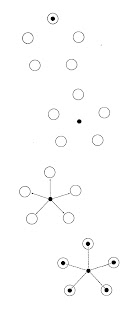
A number of conversations in the past week would point to the cute little doodle at the left representing the hoped-for evolution of self-awareness as we engage a regular mindfulness practice.

Conversation one surfaced with the guilty confession that a whole week had been consumed reading fiction -- the equivalent of 'skimming while Rome sizzled'. In short, getting lost in several good books, as it turns out, to avoid a direct look at more urgent material -- 'happily' pushed into the periphery. Conversation two, a little less explicit, made its point through some subtle, critical self-references, in an otherwise confident, self-assured individual -- begging the question of 'where'd that come from?'  And conversation three -- this from a new meditative practitioner -- commenting on the conflicted presence of an improved memory and increased emotional distress. Pretty diverse data!

What element all three seemed to share was that of a working consciousness that excluded, wholly or in part, perhaps less desirable or even feared aspects of a more complete self. In short, operating from a compartmentalized, truncated, or circumscribed self.  Back to the doodle for a moment. The schematic is borrowed from a writer on psychosynthesis, an approach to personal psychology that, like Jung and other turn of the century theorists, advocated a 'full consciousness' as the healthiest (least neurotic, in Jung's terms) approach to psychological maturity and function.

The four 'little snowflakes' represent different stages of consciousness or awareness in a given individual. The black dot identifies those elements of self of which the individual is aware and engages regularly; the small circles, various aspects or 'sub-personalities' within the individual; and the lines (or absence thereof) reflecting the degree to which the individual is aware of these aspects.  No line or connection = no awareness;  a dotted line, partial or sporadic awareness; a solid line, full awareness.  In the top diagram, we have a relatively common circumstance where a person essentially 'places all their ego eggs in one basket'. They are fully conscious of only a small part of their complete personality and are evidently quite content to live and operate in this little corner of their world. The downside of this arrangement is that, sooner or later, these other 'shadow aspects' will make their presence known; often with, because these are relatively 'foreign' to the individual, chaotic and disturbing results.

Diagram two is a slight improvement and perhaps the commonest circumstance of all. In this situation the individual has a reasonably 'balanced' ego -- but precarious, as he/she is still quite in the dark regarding all those 'relatives' lurking in the shadows; no lines between the ego/active consciousness and sub-personalities. Conversation one is an example of this: blinders in place, avoidant practices fully engaged -- all with the aim of keeping at bay vague, disturbing, or openly feared issues. An excellent recipe for anxiety.

With schematic three we're getting somewhere. A 'balanced', centrally positioned ego and an awareness of the 'siblings in the wings'. But not quite there just yet. Awareness is not acceptance or engagement. Conversation two is an example. Here the individual 'names' an aspect of self -- but in pejorative terms, suggesting shame and embarrassment around, rejection of that aspect. The 'step-sister' is acknowledged -- but sent to the woodshed. Equally conversation three has elements of this mode of function. With a newly minted mindfulness practice, he/she has moved from 'stage one', wherein avoidance of issues had (of necessity in earlier times) been so 'successful' that it bled through to interfere with attention to (and consequently memory for) just about anything that smacked of disturbing material; to stage three where, urged to 'sit with' (vs. shut out) such material, the individual had become more conscious of it, and less reactive to it -- but continues to be disturbed by its presence.

Finally, diagram four. Here we have an individual fully aware of and participating in all aspects of self. The ego is 'spread around', engaging all sub-personalities -- whether sunny or dark, socially facilitative or suspect. This individual is unlikely to be blind-sided or anxious; is likely to present as authentic in relationship; and might be seen as someone who fully knows and accepts themselves.  Part of the 'Who Am I' meditation practice is an important and courageous step toward this type of awareness. Kind of the equivalent of passing the ball to all our personal 'players' at once -- imagine how effective that would be when you've only got 12" to make that basket!